Monday, March 30, 2015

When the Emperor has New Clothes.

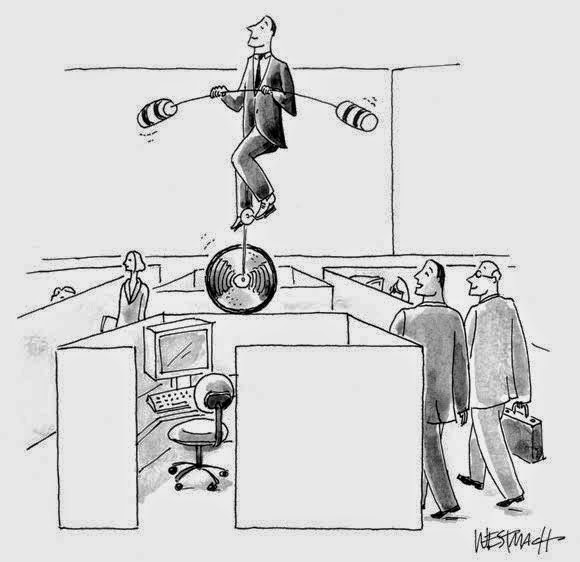
Being an agilest is like this cartoon from
the Harvard Business Review.
This is a strange time. I live near the city of Chicago so the weather in March alternates between snow, freezing rain, bright sunshine, and temperature shifts of forty degrees or more.  In this environment of uncertainty, it made me think about agile development as I understand it.  I have been doing agile as a developer and a scrum master now for six years and I have discovered a few things along the way.

As a developer, I have discovered that upper management “loves” agile and scrum.  They like seeing work turned around quickly in smaller increments with a strong commitment to quality and helping the customer.  I have also discovered that agile makes senior leadership very uncomfortable because it exposes personal and organizational weaknesses which they may not want addressed for selfish reason.  I liken this to the short story from Hans Christian Andersen “The Emperor’s New Clothes.”  I have been laid off for pointing out the nudity of an organization and it stings.

I also understand that being an agilest person in an organization can be pretty lonely.  I spent months and years explaining to a vice president who used to work for a major consulting company that all we need are user stories and interaction from the business to start building software.  I will never get over his constant look of disbelief as he saw me push code to test and then re-factor.  He also couldn't understand why I hated technical debt so much.  If wasn't broke so he didn't want to fix it.  When you explain and provide evidence why what you are doing things has merit you will often receive the blank stare accompanied by “…that is not how I learned to manage projects.”

Finally, as a developer I learned I was never good enough.  Object Oriented Development and Web Forms with ASP.NET becomes SOLID development and using Model View Controller approaches.  Coding for ten years without having to write a unit test becomes learning how to write unit tests and learning how to use fakes.  I am always learning and relearning how to do my job so that I can do it better.  In some respects, I am like a doctor or dentist learning how to improve my skills and help others.

Becoming a Scrum Master was also a new experience.  I had to confront my beginner’s enthusiasm with the realities of working with people who had no enthusiasm.  I also understood it was one thing to understand the Scrum process it was another to put it into practice every day.  The members of your team are always watching and making sure that you are living the agile principles and practicing the values of agile; courage, respect, openness, commitment, and focus.

I also discovered that some people in an organization will never understand agile.  These people have a vested interest in having things work the “old way” and no amount of increase productivity or profits will change their minds.  I have learned to isolate these people and try to by-pass their efforts.  Some people just do not want to be reminded that they are wandering through the office naked.

Why does someone choose this lonely and often frustrating path?  I do it because I think that an office should be a more humane and satisfying place to work.  I want to build software which works and that helps people.  As long as I am an agile professional, I will continue to feel this way with both my day job and my current business.  There is a better way and I am going to find it.

Until next time.

Monday, March 23, 2015

Yellow Cab should have called us.

This should not happen to your business.
I find a great deal of time is spent explaining to business people why they would need my software. This week on the blog I would like to give a relevant example why our Tony fleet management tool can save you time and money.

This week the Chicago Tribune had an article about the Yellow Cab Company in the city filing for bankruptcy.  The events moved swiftly with the company filing bankruptcy less than twelve hours after being hit with a $25.9 million judgement for a 2005 accident.  One of the companies cabs went into a drainage ditch and hit a concrete barrier causing irreparable brain damage to one of the passengers; hence the multi-million dollar judgement.

When lawyers get involved with accidents everything is going to be questioned by a jury and rival attorneys.  This means the maintenance records of the vehicles under could be subpoenaed in court.  If standard maintenance is done and you can prove it then you can limit the liability to your business when accidents happen. Unfortunately, we do not know all the evidence presented in the case but it is clear based on the news story that the accident involved driver negligence and possible break failure.

Our Tony fleet management software can help you protect your business from law suits and possible bankruptcy.  We have the ability to track maintenance and we also provide you with ways to physically archive any piece of information related to the operation of your equipment.  It works with mobile devices, tablets, and standard PC’s.  This means that you can keep track of the health of your vehicle fleet or equipment any time or anywhere.  All you need is a connection to the internet.

We work hard to build our businesses.  We should not put them in jeopardy just because we cannot keep track of paperwork or maintenance.  Contact us today, and we can show you how our Tony fleet management tool can protect your business.

Until next time.

Monday, March 16, 2015

You can learn a lot about agile from Heraclitus.

You can learn a lot from this guy.
It is funny how culture and philosophy ebb and flow over the years.  Pagan tradition are making a comeback in certain parts of Europe, Australia and the United States.  Machiavelli continues to influence art and politics.  I even see the influence of pre-Socratic philosophy in the Agile Manifesto.  This week I want to talk about a dead white guy and how he should be an influence on the agile community.

Heraclitus was born 500 years before Christ.  He is one of those thinkers college freshmen are introduced to in their introductory philosophy classes and they quickly forget him.  Philosophy is always dry but you would be surprised how much it shapes our actions and thinking. Heraclitus’ greatest observation was his statement, “The only constant in this world is change.”  This makes Heraclitus one of the intellectual forefathers of the agile movement.

I say this because Heraclitus and his notions about change match up pretty well with the Agile Manifesto which says we should “Respond to change over following a plan.”  The idea that everything is in flux an important concept that anyone in the software business can understand.  The marketplace and software is changing each day; today’s Yo can be tomorrows MySpace.  Many of the most disruptive software offerings were developed and pushed to production in a manner of days.  Over the course of weeks, these offering and items were changed to meet the demands of the market and before you know it they became dominant market leaders.

Heraclitus would also say, “You could not step twice into the same river.”  This has additional relevance to the agile community because what may have worked in past may not work now because the circumstances will have changed.  Smart Scrum Masters will understand this to be a common sense approach.  Sadly, I have seen consulting companies and business leaders apply a one size fits all approach to projects and the only thing it has done is create slow motion project failures.

So bone up on your Heraclitus and get ready to use a dash of his wit and wisdom in your next presentation.

Until next time.

Monday, March 9, 2015

It is a mobile world and you are living in it.

Any time you can combine technology trends with science fiction and a dash of British intellectualism and throw it in a blender; I am going to be curious about end product.  Fortunately, The Economist did not disappoint when they published an article about a “The truly personal computer.”  It is a great article and you should take the time to give it a read.  This week I want to discuss some of the implications of that article and what it means to your business.

Since I founded my business, I have been adamant about creating applications which work well on laptops, tablet computers, and smart phones.  Being a technology insider, I realized that this is where the money was going to be and that with the growth of smart phones we would see new demands in computing.  The latest information from the February 28th edition of the Economist bears this out.

In 2014, according to Strategy Analytics over 1.2 billion smart phones have be shipped worldwide compared with 300 million personal computers and just under 600 standard mobile phones.  If you are a business this means that if people are going to interact with your business they are going to do it via a smart device.  This is a game changer.  You are going to have to change how you do customer service.  You are going to have to have a web site that is adaptive to smaller screens.  You are also going to have to be more responsive because users of mobile devices can price compare and trade information on the go.

Social media services like Yelp mean that restaurants need to pay better attention to customer service and food quality.  I am also seeing municipalities dealing with the disruption caused by Uber which threatens to make standard taxi and limo services obsolete.  None of this would have been possible without smart phones.  So the question isn’t why haven’t you learned to adapt to this strange new world of mobile computing; the question is how are your competitors exploiting it?  If you are unable to adjust your business is in for a rude awakening.

My business makes applications for trucking and logistics companies to manage inventory, fleet maintenance, and now transform manifests into invoices via QuickBooks cloud services.  It is an exciting time and we would love to tell you more about how we can help you succeed in this new age of mobile computing.  You will be helping yourself and your business.  Stop by our website; E3 Logistics Systems or send us an e-mail we will be glad to help.

Until next time.

Monday, March 2, 2015

Behold the Ninja Lion Sensei Master Cobra certification.

This guy might be a Ninja Lion Sensei Master Cobra.
It has been quite a week.  My last blog post hit a bit of a nerve and there was lots of chatter about my feeling regarding faux titles.  This prompted many people on Google plus to get together and joke around about weird titles they heard and make up a few of our own.  Today E3 systems is proud to announce the “Ninja Lion Sensei Master Cobra” certification.

With our tongue firmly in our cheek, we created the Ninja Lion Sensei Master Cobra certification to recognize outrageous accomplishments of agile experience.  For example, if you have been trying to do an agile implementation and it has be obstructed by your executive team you might be a Ninja Lion Sense Master Cobra.

Please feel free to add other examples in the comments.

The hash tag is #nlsmc and we will have t-shirts at the Global Scrum Gathering in Phoenix.  I look forward to not taking ourselves too seriously in May.

Until next time.

Monday, February 23, 2015

You are not a ninja!

Agile professionals are NOT ninjas!
Like most professionals, I tend to get ornery from time to time.  I am beginning to think that this is a healthy response to working in present day corporations.  Human beings have gone from being hunter gatherers to living in cubical farms in the span of 5,000 years.  It does not surprise me that there is not some kind of psychological backlash to this situation.  Further changes in the professional world like the hoteling of work spaces and the growing dependency on contract workers has made life in the corporate world seem like something out a Franz Kafka novel.  Today, I want to talk about something that have been bothering me over the last few weeks.  The growth of faux titles that agile professionals are using to try and describe themselves.

My irritation began when I noticed that someone began using the phrase “code ninja” to describe themselves and scrum master skills.  I have already blogged about what I think about people who describe themselves in this manner.  Now, I am seeing terms like “Agile evangelist” and “Wizard” cropping up in some discussions about agile professionals.  I understand why people are doing this to try and brand themselves and make themselves more appealing to the market but it really needs to stop right now.

We are agile professionals.  We are not wizards pulling rabbits out of our pointy hats and summoning a Patronus when an impediment crops up.  We are not Jedi because I doubt we would ever get the licensing from Disney to use the title and we don’t have cool light sabers.  This also means we have to deal with Sith and frankly the thought of executives with the power to force choke is a little disconcerting.  We are not ninjas because even though we are highly skilled professionals we are not being asked to kill people.  Finally, we are not evangelists.  Evangelism requires blind faith, total dedication, and the commitment to orthodoxy.  That is the antithesis of Agile.

Agile requires its practitioners to try new things.  One of the tenants of the manifesto, is we respond to change over following a plan.  Pragmatism, the scientific method, good engineering, and relying on a community of professionals is what makes us agile.  Contemporary evangelism tends to shun these values.  I will concede that it does take a leap of faith to try and change how contemporary business is done but we are no different than the professionals who applied W.E. Deming’s methods in Japan or the lean manufacturing professionals currently practicing in the United States.

Finally, if you call yourself an agile apostle and you are not one of the original signatories of the Agile Manifesto you deserve a good dose of scorn and ridicule.  Agile was not dictated to us like the Koran to Mohamed or revealed to us via golden tablets to John Smith.  It is the product of thousands of people attempting to pull business out of the 19th century and into the 21st. It is changing and evolving and responding to change.

Drop the silly titles and let your work speak for itself.  We are Scrum Masters and Agile Coaches.  We are servant leaders trying to help others be more productive and content with their careers.  We need to get our hands dirty, refactor code, attend meetings, deal with the personal problems of our developers and try to make a difference in the lives of the people we work with.  This is not glamorous or flashy work but it needs to be done.  I you want to call yourself a ninja or Jedi then I think we are not going to work well together.  Don’t worry those of us exhibiting the quite professionalism the job requires will still be here to clean up your messes.

Until next time.

Monday, February 16, 2015

Never be ashamed of failure.

This is a epic fail.
I am a professional Scrum Master and entrepreneur.  When I tell others about this, they have a perception of me as a hard charging success junky.  The reality is more complex and depressing.  This week on the blog I want to discuss failure and how it shapes you as a professional.

From the moment you enter middles school until you graduate, you are place in competition with others.  An “A” is the pinnacle of work while an “F” is equated with failure.  You are given class ranking and placed in a pecking order based on academic performance.  You are consistently reinforced by your teachers that your performance in the classroom will impact your life.  A good student has a chance to escape his or her mundane middle class life.  A poor one will be condemned to flipping burgers or dancing with a brass pole.

From a learning perspective, failure was discouraged and success gateway to further success.  In hind sight, it seem like educational malpractice.  Some of the most important lessons I have learned have come from mistakes.

This situation is further exacerbated when you leave school and enter the work force.  Sales people are judged on the amount of revenue they generated.  T.V. news casters on their ratings.  Programmers on how many hits they receive on their web sites or how many times their app is downloaded.  The numbers are merciless and cruel.  As an entrepreneur, I am judged on how much money I have raised or made for my business.

By any objective measure, I have been a failure.  I have been in business for five years and finally have made enough money to finance the business without having to dip into my own personal savings.  I have done part time consulting to keep my software start-up afloat.  In the meantime, I work full time during the day to keep myself in health care and pay my mortgage.  The Silicon Valley dream of having my own company is still a long way off.

My career have been a series of misadventures being laid off and fired from so many technology jobs that I do not even know how to describe it to others.  In that time, I have gained a tremendous amount of wisdom.  I have been forced to reinvent myself six times of the last 25 years.  I have taken these experiences and applied them to how I have led my technology teams.  It seems that those failures and the wisdom I have gained from them have made me a better leaders.  I also think it will help me when success pays me a visit.

There is a saying in the agile world, “Fail early and often.”  I have lived by that virtue my entire life.  I am still obsessed with success but now I have the experience which will prevent me going insane when success decides to visit.  Failure informs success and makes you able to deal with adversity.

So here I am, a failure.  I have governed most of my life but it has not defeated me.  It has made me stronger and more resilient for the success to come.

Until next time.